- English
- Español
- Português
- русский
- Français
- 日本語
- Deutsch
- tiếng Việt
- Italiano
- Nederlands
- ภาษาไทย
- Polski
- 한국어
- Svenska
- magyar
- Malay
- বাংলা ভাষার
- Dansk
- Suomi
- हिन्दी
- Pilipino
- Türkçe
- Gaeilge
- العربية
- Indonesia
- Norsk
- تمل
- český
- ελληνικά
- український
- Javanese
- فارسی
- தமிழ்
- తెలుగు
- नेपाली
- Burmese
- български
- ລາວ
- Latine
- Қазақша
- Euskal
- Azərbaycan
- Slovenský jazyk
- Македонски
- Lietuvos
- Eesti Keel
- Română
- Slovenski
- मराठी
- Srpski језик

How Does a 6-Pin Rocker Switch Work?
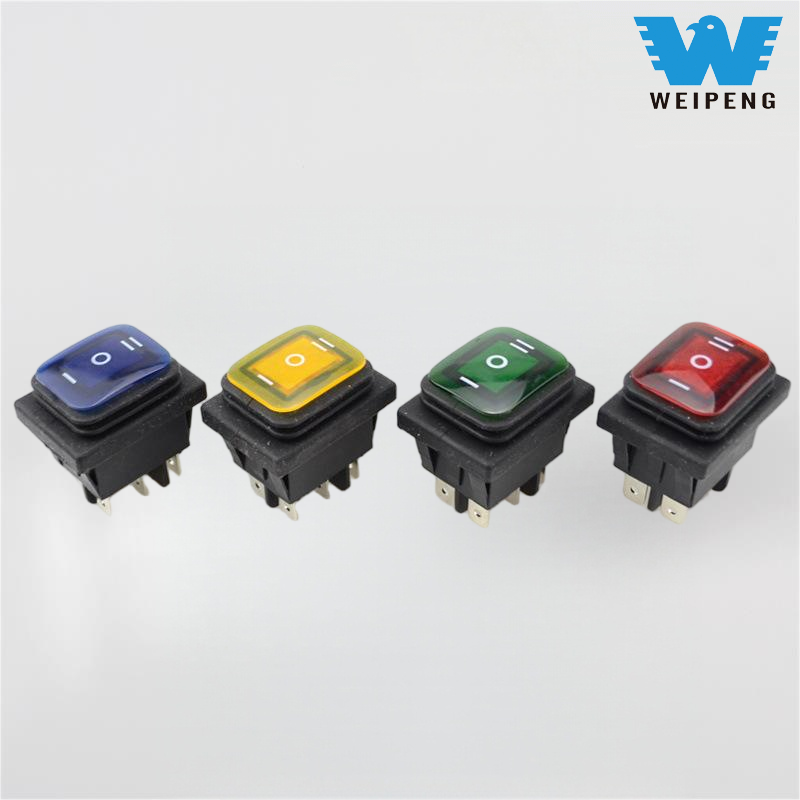
You’ve probably flicked one without thinking twice. That satisfying click of a rocker switch is everywhere—on your sump pump, a car seat heater, or a bench grinder. But when you flip a standard light switch, you only break one wire. So why does a 6-pin rocker switch need six metal prongs hiding underneath? Because this little component isn’t just an on/off button. It’s a tiny traffic cop. It controls two independent circuits at once, and in some cases, it lights up to tell you the power is live. Let’s pop the hood and see what those pins actually do.
A 6-pin rocker switch is a double-pole, double-throw (DPDT) switch. In plain English, that means it can control two separate devices or two functions of one device simultaneously. Unlike a simple 2-pin switch that just cuts a single wire, this one is for more complex jobs where you need to reverse a motor or switch between two power sources.
To understand how it works, you need to know the pin layout. You don’t need an engineering degree; just think of them in pairs.
- Pin 1 & 2 (The Inputs): These are your "common" terminals. They usually connect to your main power source (the battery or wall adapter).
- Pin 3 & 4 (Output Set 1): These connect to the first device or the first function (e.g., "forward" on a motor).
- Pin 5 & 6 (Output Set 2): These connect to the second function (e.g., "reverse").
What Happens When You Flip It?
Here is the magic trick. The rocker has a metal bridge inside that moves when you press it.
- Position 1 (Up/On A): The bridge connects Pin 1 to Pin 3, and simultaneously connects Pin 2 to Pin 5. Power flows to Function A.
- Position 2 (Center/Off): Nothing connects. The bridge sits in neutral. The circuit is dead.
- Position 3 (Down/On B): The bridge connects Pin 1 to Pin 4, and Pin 2 to Pin 6. Now power flows to Function B.
As a buyer, you usually only need a 6-pin rocker switch for two specific problems:
1. Reversing a DC Motor: Think of a winch or a lift. You need to send positive voltage one way to go up, and reverse the polarity to go down. A 4-pin switch can’t do this safely, but the 6-pin design handles the "crossover" internally.
2. Dual Voltage Control: Maybe you have a device that runs on 12V and 24V, or you want to choose between "battery power" and "generator power." This switch isolates both lines.
The Light Issue (A common buyer headache)
Many 6-pin rocker switches have a built-in LED. However, these lights require a ground path. If your switch isn't lighting up, don't assume it's broken. You likely need to run a specific ground wire to the "ground" pin (often Pin 7 or a separate terminal, depending on the brand). If you ignore the LED, the mechanical switching still works fine.
The Takeaway
Forget the complex wiring diagrams for a moment. Just remember: a 6-pin rocker switch is two separate 3-pin switches glued into one housing. It exists to handle two different actions (like high/low speed or forward/backward) using a single button. If your project requires reversing a motor or managing two power sources, you finally know why the basic 2-pin switch wouldn't cut it.