- English
- Español
- Português
- русский
- Français
- 日本語
- Deutsch
- tiếng Việt
- Italiano
- Nederlands
- ภาษาไทย
- Polski
- 한국어
- Svenska
- magyar
- Malay
- বাংলা ভাষার
- Dansk
- Suomi
- हिन्दी
- Pilipino
- Türkçe
- Gaeilge
- العربية
- Indonesia
- Norsk
- تمل
- český
- ελληνικά
- український
- Javanese
- فارسی
- தமிழ்
- తెలుగు
- नेपाली
- Burmese
- български
- ລາວ
- Latine
- Қазақша
- Euskal
- Azərbaycan
- Slovenský jazyk
- Македонски
- Lietuvos
- Eesti Keel
- Română
- Slovenski
- मराठी
- Srpski језик

Long Arm Micro Switch: A Practical Guide to Selection, Applications, and Buying Tips
The Long Arm Micro Switch is an extremely compact snap-action switch with an extended lever actuator. The long arm of the switch offers more flexibility than a regular plunger-type micro switch when detecting movement, position, or mechanical contact. Long Arm Micro Switches are often used in a variety of applications such as appliances, industrial equipment, automation systems, vending machines, safety devices, office equipment, and many other electromechanical products. The long arm allows for a greater distance between the movement of the actuator and the switch, reducing the amount of force needed to actuate the switch. As a result of these features, they are frequently used throughout the electromechanical market.
Determining which Long Arm Micro Switch to buy for buyers, engineers, and sourcing teams is not solely based on size. Electrical rating, actuator style, actuating force, terminal style, durability, installation space requirements, and the environment in which the switch will be used can all affect how well the switch functions and how long it will last. This article explains how the Long Arm Micro Switch works, where the switch can be used, and different things to look for before purchasing a Long Arm Micro Switch.
What is Long Arm Micro Switch?
A Long Arm Micro Switch is an example of a micro switch that has a lever arm attached to the actuator. The actuator lever is pressed or moved by another object and causes the internal spring mechanism to quickly change the electrical contact state of the switch. Because of this snap-action feature, the Long Arm Micro Switch can be extremely reliable regardless of whether the object that actuates the switch has slow, light, or unstable movement.
The Long Arm provides a greater distance between the actuating element and the actuating point of the switch than a standard micro switch. Additionally, the longer lever arm makes the switch easier to actuate when compared to a standard micro switch. In product specifications, you may find terms for similar product types such as micro switch lever arm, long lever micro switch, snap-action switch with lever, limit micro switch, and miniature lever switch. These generally refer to products of similar function; however, dimensions, actuator configurations, and electrical ratings may differ from model to model.
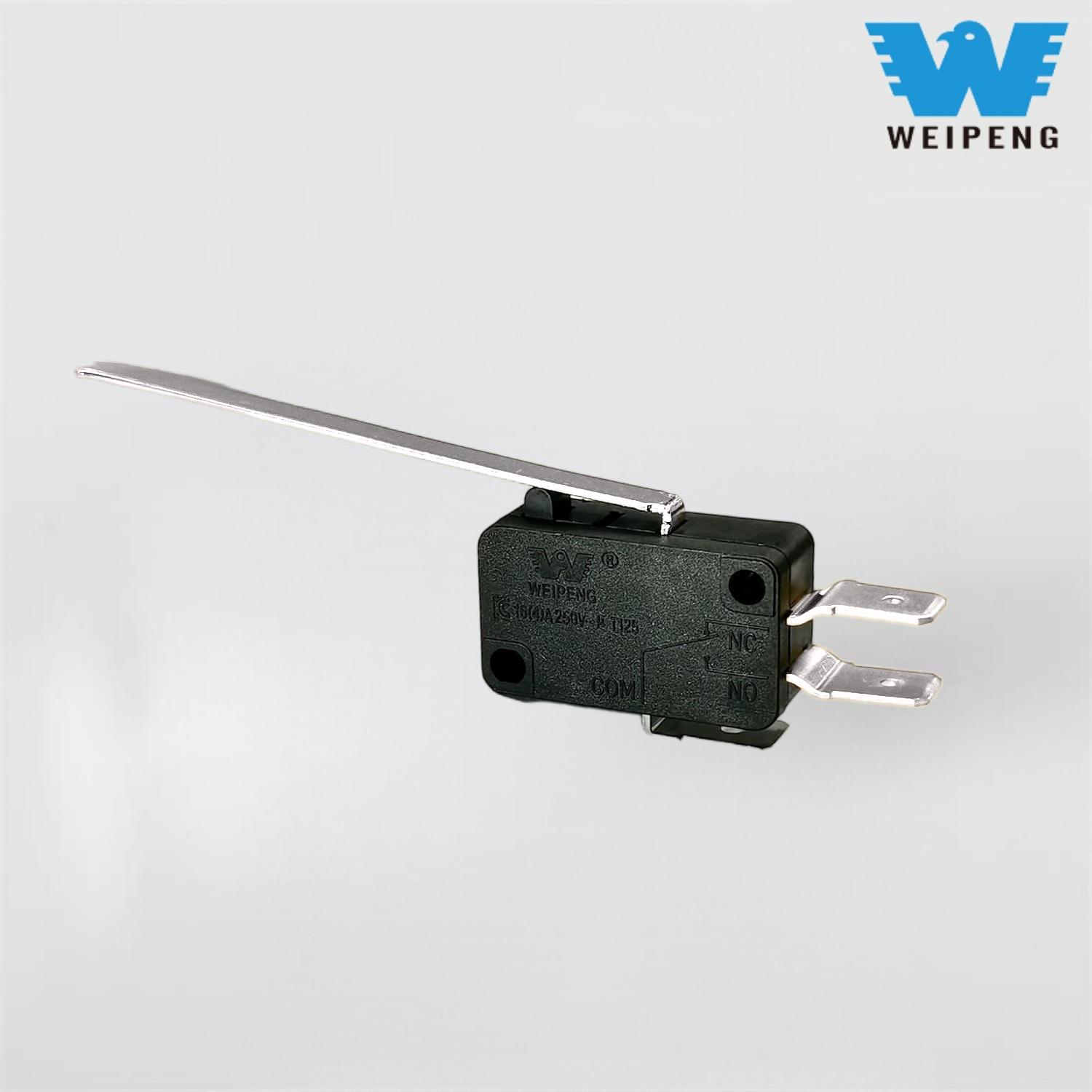
The Functionality of A Long Arm Micro-Switch
Within the housing of the micro switch, fixed and movable contacts are connected to a spring-action mechanism. When in its normal position, the circuit may be either closed or open depending on how it was wired through the normally open or normally closed terminal. The applying force through the lever arm is transferred to the activating element inside the micro switch. When the applying force reaches the operating point, the snap-action mechanism changes the contact state almost instantly before returning to the original position once the applying force has been removed.
This quick transition decreases contact arcing, increases the accuracy of signals produced, and improves the mechanical longevity of the contacts. For these reasons, micro switches are commonly used in applications where there will be frequent cycle switching, precise detection, compact installations, and consistent electrical output.
Where Long Arm Micro Switches are Commonly Used
The Long Arm Micro Switch is widely used in many industries due to its compact size, precision, and very simple mechanical integration. In homes, they are used in appliances such as microwave ovens, washing machines, dishwashers, coffeemakers, refrigerators, and air conditioning units to detect door interlock open or closed conditions, lid position, and water level for operational functions and safety control.
In industrial and commercial use, long arm micro switches are commonly used as limit switches, position sensing devices, and safety switches. They are also extensively used in vending machines, arcade machines, office equipment, electric locks, medical devices, 3D printers, packaging machines, and automotive accessories. They provide an economical means of converting mechanical movement into an electrical signal.
Types Of Lever Arms and Actuator Designs
There are several different shapes of lever arms available for micro switches with long arm levers. A straight long lever is the most common style and is used for general positional detection and basic mechanical contact. Roller levers utilize rollers at the end of their levers, making sliding across the switch less of a burden on the object and reducing friction. Simulated roller levers have a curved end to their arm in place of a traditional rotating roller and therefore offer smoother contact with lower cost.
When selecting a micro switch with a particular lever arm, take care to verify the direction of lever motion, as hitting it at an incorrect angle may damage it and cause premature failure. The stability and service life of any long arm micro switch can be greatly enhanced by ensuring that proper alignment, lever length, and release space are present.
How to Select a Long Arm Micro Switch
The best way to select a switch is to begin with the working parameters of the switch. You need to consider what will be detected by the switch, how frequently the switch will be activated, how much current will flow through the switch, and what conditions the switch will be subjected to. If you are switching signals at low voltage, then contact reliability and stable operation may be more critical than switching high amounts of current. If you are switching motors or power, then you need to place a higher emphasis on electrical ratings and contact materials.
It is important to measure mounting hole spacing, body size, lever position, and terminal orientation as well. Assembly tends to be influenced by even a small dimension change. Send your vendor installation information such as pictures, drawings, voltage/current ratings, terminal information, and part numbers when replacing a device with an existing model. For new product development, test samples under actual operating conditions before mass production so that you know if the operating force, contact reliability, and installation tolerances are met.
Long Arm Microswitch Purchasing Recommendations
When purchasing a Long Arm Micro Switch on behalf of OEM production or maintenance needs, purchasing from someone that can provide continuity is just as important as price. If you purchase a low-cost switch that gives you varying degrees of push-in force or fails very soon after you purchase it, you will incur significant costs for product returns, downtime, or product complaints. Look for suppliers that can provide technical assistance, are capable of consistent production, and offer clear documentation and certification of the switch.
While a micro switch lever arm may not appear to be very significant, it is critical to safety, control, and user experience. By knowing the actuator style, electrical rating, installation condition, and quality of long-arm microswitches, anyone purchasing a micro switch lever for an appliance, compact limit switch, or durable detection switch for OEM projects can select a switch that gives reliable service throughout the life of the application with minimal trouble and service downtime.
Previous:What is a 3-Way Rocker Switch?